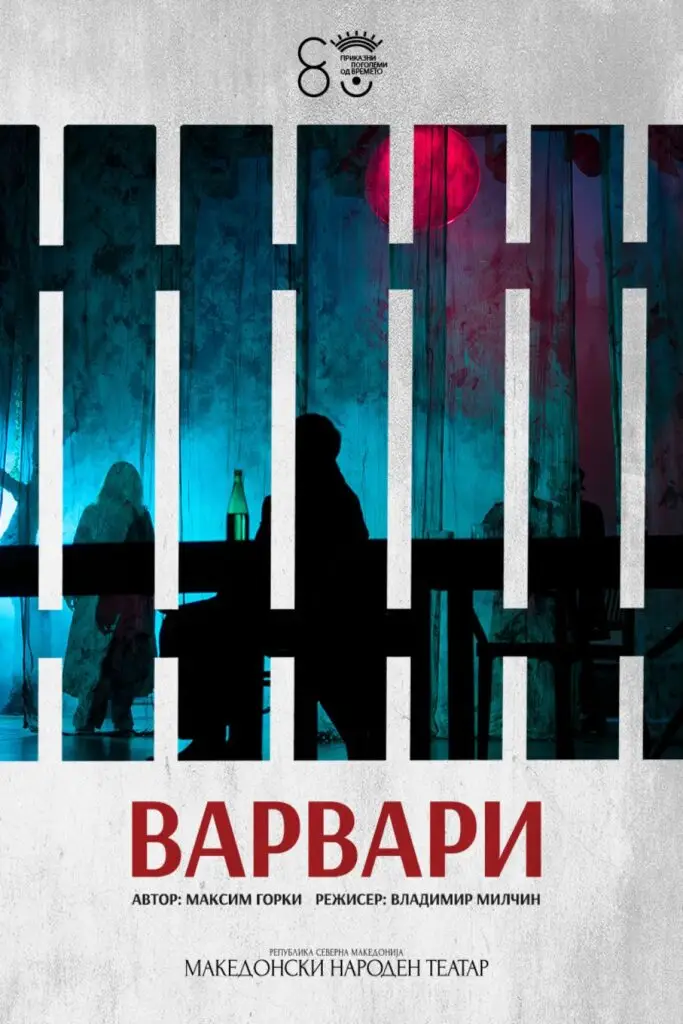
VARVARI
Maxim Gorky
Director: Vladimir Milchin
Set Designer: Bedi Ibrahim
Costume Designer: Marija Pupuchevska
Translation: Ema Markovska Milchin and Vladimir Milchin
Assistant Director: Shenaj Mandak
Assistant Set Designers: Bojana Isijanin and Martin Manev
Assistant Costume Designer: Angela Bogeska
Music Selection: Vladimir Milchin and Ema Markovska Milchin
Executive Producers: Viktor Ruben and Simona Ugrinovska
Duration: 165 minutes
Intermission: Yes
Stage: Main Stage
On June 18, 1936, Radio Moscow reported the death of Maxim Gorky, a "great Russian author, a brilliant artist of the word, a friend of the workers, and a fighter for the victory of communism." Although a state funeral was organized for him, Maxim Gorky died a conflicted figure, having struggled to maintain a balance between his artistic consciousness and conscience and his loyalty to Stalin's regime. The Kremlin honored Gorky with a state burial, and nearly half a million people passed by his coffin in a special chapel in central Moscow. After cremation, the urn with his ashes was placed on an ornate litter and carried to Red Square on the shoulders of Stalin and his associates, under the watchful eyes of the police and the army. Once the ceremony concluded, the urn was buried in the Kremlin Wall Necropolis, which went against the writer's final wish—to be buried next to his son at the Novodevichy Cemetery. Alexei Maximovich Peshkov took the pen name Maxim Gorky (literally "Maxim the Bitter") early in his youth. By writing about tramps and other marginalized individuals in his works, a multitude of characters from the lower social classes was introduced into Russian literature for the first time. Gorky himself lived at the bottom of society and thus had firsthand experience of suffering. Gorky's literary fame began before the revolution, and his works were highly regarded by luminaries such as Tolstoy and Chekhov. Gorky became a close friend of Lenin at the turn of the century; thus, when the Bolsheviks came to power, Gorky was able to defend many writers and poets persecuted by the regime. Lenin eventually grew tired of Gorky's interventions on behalf of unpopular intellectuals and convinced him to go abroad to improve his health. After leaving Russia in 1921, Gorky traveled through Europe with his family before settling in the Italian city of Sorrento. Meanwhile, Lenin died and Stalin took power. He was determined to use art as a means of shaping society and sought a famous writer to justify Stalinism. He chose Gorky. The writer returned to the USSR in 1932, where he was welcomed with great honors. However, as the 1930s progressed, Gorky's position in Soviet society became increasingly conflicted. The First Congress of the Union of Soviet Writers was scheduled for the summer of 1934, and Gorky was asked to deliver the opening speech. But in May of that year, the writer's son, Maxim Peshkov, died a few days after returning from a drinking session with Genrikh Yagoda, the head of the NKVD. It was speculated that Maxim was murdered to intimidate Gorky and prevent him from making undesirable comments or inflammatory speeches during the Congress. The tension between Gorky and Stalin continued to grow until relations were definitively severed in July 1935. Gorky withdrew from the First International Congress of Writers in Paris at the last moment, citing health problems. Although Gorky was indeed seriously ill with tuberculosis, Stalin saw this as an unpardonable betrayal, especially since the event was organized by Russia. Gorky was forbidden from communicating with foreign writers and was placed under constant surveillance, virtually imprisoned in his villa in central Moscow. There are rumors that in his final years, Stalin asked Gorky to write his biography, but the writer categorically refused. Russian historian Arkady Vaksberg claims that Gorky did not die of a heart attack, as the official version states, but was poisoned on Stalin's orders. However, this remains unproven, and the writer was very ill in the final stage of his life. The drama "Barbarians," published in 1906 in Russian and German, takes place in a remote provincial town where two engineers are sent. They are to manage the construction of a railway line, which is supposed to bring capitalism and make the residents happy. Hopes are high, calculations even higher, but the results are disappointing. In the clash between "wooden and iron Russia," in which the "iron" extracts everything of "value" from the "wooden," the problem of the intelligentsia is addressed. The carriers of bourgeois civilization in the play are the engineers Cherkun and Tsyganov, who arrived in the remote town of Verkhopolye to build the railway. From the very beginning, Tsyganov is seen as a vile cynic and a corrupter of human souls. Under his toxic influence, Redozubov's son starts drinking, the young peasant Matvey Govin becomes greedy, hoarding money to "buy" a wife, and the official Drobjazgin steals state funds... Corrupting people gives Tsyganov true pleasure, confirming his "zoological" theory. At first, Cherkun seems different—an energetic, persistent, and hardworking man, though somewhat linear in his views and actions. His wife Anna, as well as Lidiya Pavlovna, who seeks noble ideals, and Nadezhda Monakhova, who longs for true love, are drawn to him for a reason. However, Cherkun also turns out to be a cynic and egoist, like Tsyganov. He is angry at people, wanting to settle scores for his past humiliations; he tramples on his wife's love, pushes Lidiya Pavlovna away, and drives Nadezhda Monakhova to suicide. One of the characters in the play calls Cherkun and Tsyganov barbarians. The student Stepan Lukin stands against these bourgeois "civilizers." He knows well that "life is full of crimes," knows they must be ended, and that "iron people are needed if they want to rebirth life." But he also knows he lacks the strength for the battle... In his letter regarding the premiere, Gorky advised paying attention to the character of Monakhova: "She sincerely believes in the possibility of some great, fiery, and pure love; she believes in the hero-man worthy of her love. From the first meeting, she falls in love with the engineer Cherkun because of his bold eyes and sharp, decisive movements, thinking: 'Here is the hero-man!' Submissively but confidently, she watches him, waits for him. She cannot help but think that he is for her and she is for him. In the final act, she suddenly cannot believe her mistake, but when she realizes it, her heart dies." On the stage of the Macedonian National Theatre in the 1950s and 1970s, Maxim Gorky's plays "The Philistines" (1951), "The Lower Depths" (1954), and "Children of the Sun" (1973) were performed.
Cast
CHERKUN, YEGOR PETROVICH, engineer – Toni Mihajlovski
ANNA FYODOROVNA, his wife – Gabriela Petrushevska
TSYGANOV, SERGEY NIKOLAYEVICH, engineer – Nikola Ristanovski
BOGAYEVSKAYA, TATYANA NIKOLAYEVNA, landlady, landowner – Zvezdana Angelovska
LIDIYA PAVLOVNA, her niece – Sofia Nasevska – Trifunovska
REDOZUBOV, VASILIY IVANOVICH, mayor – Vlado Jovanovski
GRISHA, his son – Grigor Jovanovski
KATYA, his daughter – Ana Stojanovska
PRITYKIN, ARKHIP FOMICH, merchant, timber industrialist – Oliver Mitkovski
PRITYKINA, PELAGIYA IVANOVNA, his wife – Tanja Kochovska
MONAKHOV, MAVRIKIY OSIPOVICH, tax collector – Aleksandar Mikić
MONAKHOVA, NADEZHDA POLIKARPOVNA, his wife – Verica Nedeska
GOLOVASTIKOV, PAVLIN SAVELYEVICH, a citizen – Sashko Kocev
DROBYAZGIN, clerk at the local treasury – Gorast Cvetkovski
DOCTOR MAKAROV – Jordan Simonov
VESELKINA, MARIYA IVANOVNA, postmaster's daughter – Sashka Dimitrovska
POLICE CHIEF – Emil Ruben
IVAKIN, IVAN IVANOVICH, gardener and beekeeper – Aleksandar Gjorgjieski
LUKIN STEPAN, student, her nephew – Damjan Cvetanovski
DUNYKA’S HUSBAND, a man of no occupation – Ivica Dimitrijević
MATVEY GOGIN, farmhand – Aleksandar Mihajlovski
STYOPA, Cherkun’s housemaid – Jana Veljanovska
YEFIM, Ivakin’s worker – Stefan Spasov
CREATIVE AND TECHNICAL TEAM
Set Designer: Bedi Ibrahim
Costume Designer: Marija Pupuchevska
Translation: Ema Markovska Milchin and Vladimir Milchin
Assistant Director: Shenaj Mandak
Assistant Set Designers: Bojana Isijanin and Martin Manev
Assistant Costume Designer: Angela Bogeska
Music Selection: Vladimir Milchin and Ema Markovska Milchin
Executive Producers: Viktor Ruben and Simona Ugrinovska
Stage Manager: Aleksandar Rajkovski
Prompter: Tanja Ivanovska
Photographer: Kire Galevski
Poster and Program Catalog Designer: Dimitar Dimitrov
Program Catalog Editor: Zagorka Pop-Antoska Andovska
Text and Program Catalog Proofreader: Jana Petrevska
Technical Director: Gunter Kube
Technical Services Coordinator: Ivica Urdarević
Lighting Engineer: Daniela Atanasova
Lighting Designer: Igor Mitrevski
Master Electrician: Igor Georgiev
Lighting Operator: Gorjan Temelkoski
Sound Designer: Aleksandar Petrovski
Sound Master: Stefan Mihajlovski
Video Operator: Aleksandar Aceski
Fly System and Stage Machinery Operators: Vasko Bojadziski, Goran Dimov and Trajche Tasevski
Wardrobe: Valentina Chonkova, Skender Berisha and Elizabeta Stamchevska
Property Masters: Snezhana Grncharevska, Pavle Kralevski and Danil Cvetkovski
Makeup and Hair: Branka Pljachkovska and Lora Spasovska
Stagehands: Vasil Meshkovski, Dejan Stamchevski, Nedzat Asan, Burhan Muaremi, Martin Kitanovski, Sinan Rakipovski, Ibrahim Ramanovski, Nerhan Osmanovski, Husein Halili, Zekirija Alim and Durmish Sefer
Set Construction: Tatjana Hristoska (workshop manager), Angel Petrovski (sculptor), Darko Dukovski (sculptor), Zoran Minovski (locksmith) and Ilija Nikolovski (carpenter)